Proxy reseller software is the operational layer between your upstream proxy supply and your customers. It converts provider accounts into products with your routing, credentials, limits, usage, API, dashboard, and brand.
That definition is deliberately wider than “reseller panel.” A panel can create users and show a balance while the most important work remains in scripts, provider dashboards, spreadsheets, and the heads of two engineers. It looks complete in a demo and becomes fragile under real traffic.
I work on this layer every day. When we review an existing reseller stack, the hardest problems are normally behind the interface: conflicting provider targeting, session state, delayed accounting, partial failures, and no safe way to replace a supplier without changing the customer contract.
A panel is a screen; a platform owns behaviour
A simple panel records customers, orders, and perhaps credentials. A complete platform must also decide what happens for every authenticated proxy connection. It needs to answer:
- Is this credential active and which package does it use?
- Is the requested country allowed by that package?
- Which upstreams can fulfil the exact request?
- Which of those upstreams are healthy now?
- Does a sticky-session binding already exist?
- How much traffic may this customer still use?
- Where is usage written so it can be audited later?
- What can an operator inspect without exposing supplier secrets?
If these decisions live outside your reseller software, the panel is not the system of record. It is a decorative view over several unrelated systems.
The 15 capabilities a real platform needs
The precise implementation changes by business, but the capability map is stable.
1. Upstream management
Operators need a safe place to configure suppliers, endpoints, authentication, available proxy types, targeting, cost context, and operational state. Secrets must be encrypted or placed in a proper secret store, never returned to customer clients, and excluded from routine logs. Configuration, validation, and permission to receive production traffic should remain separate states.
2. Provider adapters
Every supplier has its own hostname, username grammar, region names, error responses, and rotation semantics. An adapter translates the platform’s internal request into that supplier’s connection format. Without it, upstream syntax leaks into products and customer credentials, turning a provider change into a customer migration.
3. HTTP and SOCKS5 gateways
The gateway is the high-throughput data-plane entry point. It terminates customer authentication, parses targeting, enforces policy, opens the upstream connection, streams traffic, and reports usage.
HTTP CONNECT and SOCKS5 are not merely two labels on the same handler. They have different negotiation, error, address, and authentication details. Test both with long-lived and concurrent connections if both are in the product.
4. Product-aware routing
Routing begins with what a customer purchased. A datacenter package should not enter a residential pool because another route is cheaper. Exact country targeting should not widen silently when a country is unavailable.
After product and target eligibility, the engine filters health and applies weights or another policy. The order matters. We explain the full sequence in the multi-provider routing guide.
5. Session affinity
A sticky session binds a public customer key to a suitable upstream identity. The platform needs a shared or deterministic binding strategy, expiration, invalid-target handling, and a policy for unhealthy routes that operators can diagnose without exposing upstream credentials.
6. Customer credentials
Proxy authentication must be fast, revocable, and scoped to a customer product. It should support rotation and, when needed, sub-users with their own limits. Dashboard passwords and proxy passwords require separate storage and lifecycle rules.
7. Usage accounting
The platform needs authoritative traffic counters and a durable ledger. A total balance alone cannot explain a dispute, support a credit, or reconstruct what happened after an incident. Define billable directions and connect usage to the customer, package, credential or sub-user, and time period.
8. Limits and concurrency controls
Bandwidth allowances, package validity, connection limits, and sub-user quotas need enforcement near the request path. Distributed gateways must also reconcile concurrent updates; a nightly job is not a hard quota.
9. Products and packages
Products translate infrastructure into commercial rules. They define eligible pools, targeting, session behaviour, price, allowance, renewal period, and customer visibility.
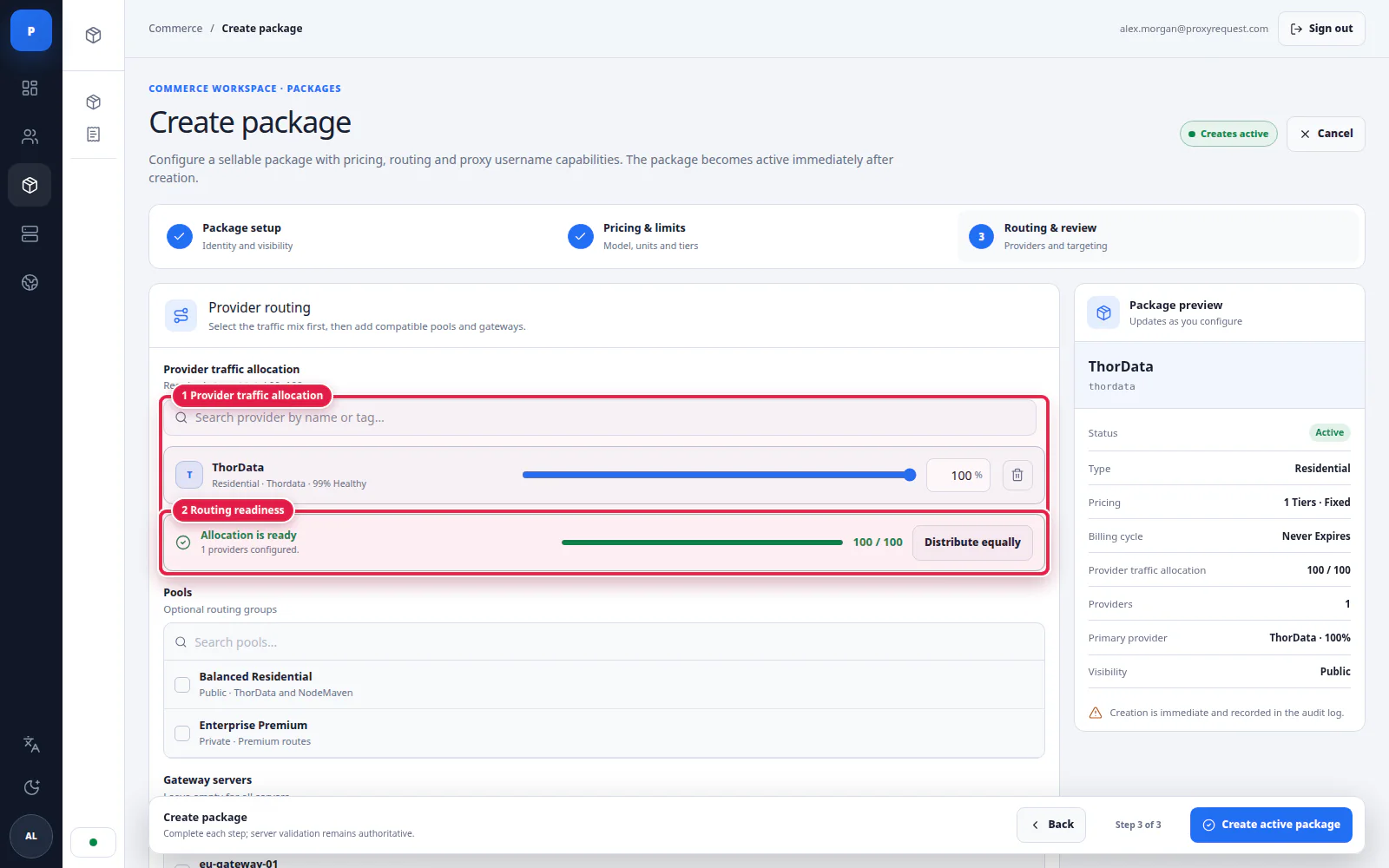
10. Orders, billing, and credits
Commercial state needs explicit transitions. An order can be pending, paid, failed, refunded, or cancelled. A package assignment can be scheduled, active, expired, or revoked. Webhooks must be idempotent, and operator adjustments need a reason and audit record.
11. Customer dashboard
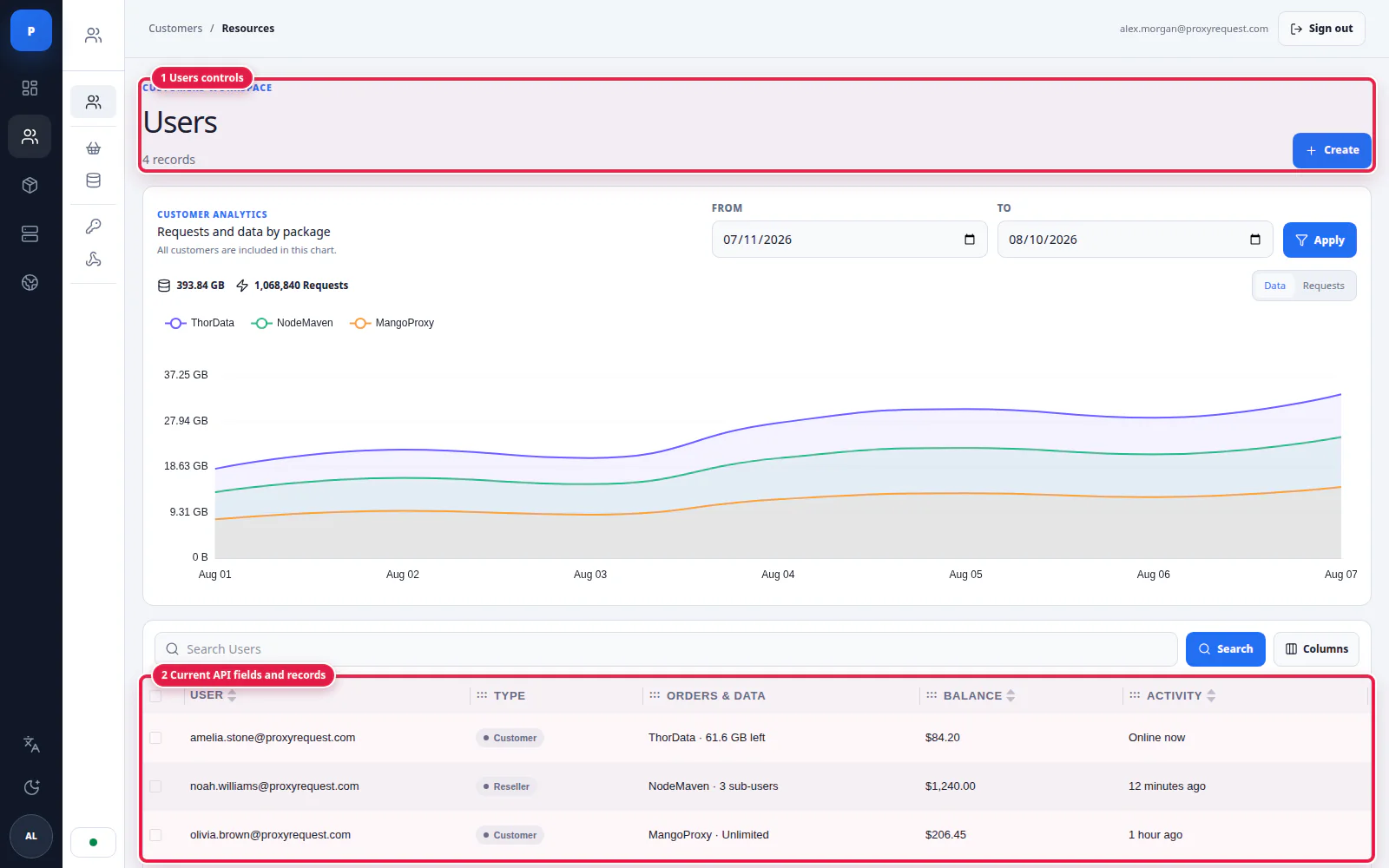
The dashboard should let a customer understand what they bought and use it without exposing internal tables. The essentials are services, remaining usage, credentials, connection examples, usage analytics, invoices, API access, and support.
12. Operator console
Operators need different workflows: onboarding supply, creating pools, defining packages, assigning customers, investigating usage, rotating secrets, disabling a broken route, and reviewing infrastructure health.
13. Public API and webhooks
The public API should expose business operations rather than upstream internals. Stable identifiers, pagination, scoped keys, idempotent commands, clear errors, and webhooks allow customers to automate provisioning without sharing operator access.
The ProxyRequest API resource map shows how resources are organized around integration tasks.
14. Analytics and support evidence
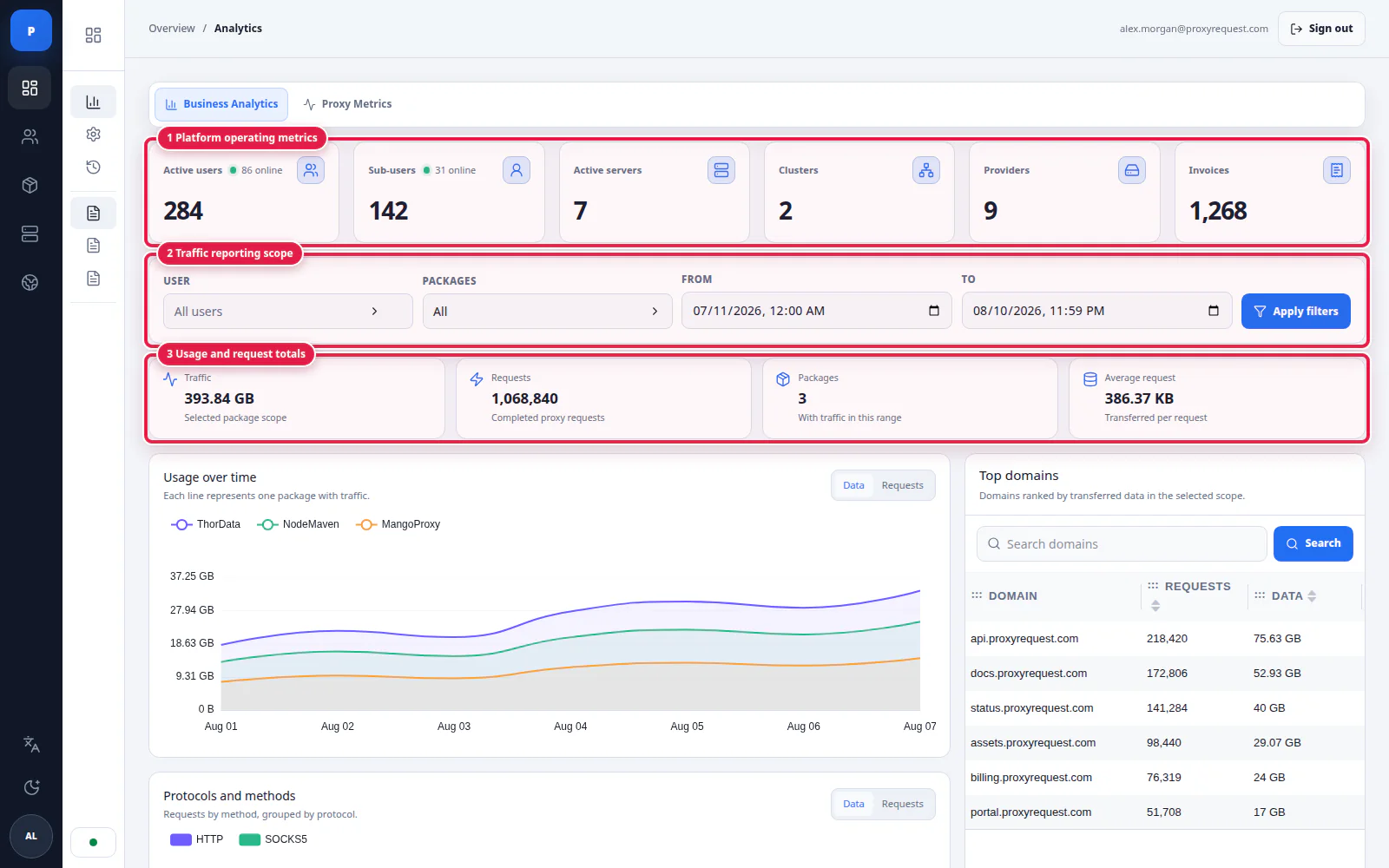
Customers need understandable usage. Operators need more: success, latency, traffic, error category, gateway, provider route, country, and time. These views must share definitions so that a dashboard number can be reconciled with the ledger.
15. Deployment, monitoring, and recovery
Software delivery is part of the product. You need repeatable deployments, health checks, metrics, structured logs, alerting, backups, migration procedures, secret rotation, and a tested recovery path through schema and gateway changes.
Simple reseller panel versus operational platform
| Capability | Simple reseller panel | ProxyRequest-style platform |
|---|---|---|
| Customer dashboard | Usually | Yes |
| Product and order records | Usually | Yes |
| Multiple independent upstreams | Sometimes | Yes |
| Provider adapter layer | Limited | Yes |
| Product-aware routing engine | Rarely | Yes |
| Health filtering and failover | Rarely | Yes |
| Shared sticky sessions | Varies | Yes |
| Supplier abstraction | Limited | Yes |
| Gateway-level traffic accounting | Basic or upstream-reported | Ledger-backed |
| Own proxy gateways | Often no | Yes |
| Operator analytics | Basic | Route and infrastructure views |
| Public API and webhooks | Varies | Yes |
This is not a claim that every business needs the larger system on day one. A single-provider experiment may be served by that provider’s panel. The point is to know what the chosen tool owns, and which operational responsibilities remain with you.
How multi-provider support changes the software
Adding a second supplier affects much more than a dropdown. The platform must normalize target models, define eligible pools, compare health, make weighted choices, preserve sessions, reconcile usage, and produce one public error model.
one gateway→Eligibility
health
weights
session→
Eligibility and health must be resolved before weights. The multi-provider routing guide covers this request path without duplicating it here.
What white-label should mean
White-label should cover the customer contract—domains, gateway, credentials, errors, dashboard, API, and support output—while preserving deep upstream detail for trusted operators. The white-label software guide explains that ownership boundary.
Questions to ask a reseller software vendor
Ask for behaviour, not feature words.
- Does “multi-provider” mean manual switching, or can one product use a governed pool?
- What happens to an existing sticky session when a route becomes unhealthy?
- Can the gateway enforce exact geography during failover?
- Which byte directions count, and where can an operator audit a debit?
- Are customer and sub-user limits enforced in real time?
- Which upstream details can appear in errors, DNS, headers, API data, or logs?
- Can the service use your domain for dashboard, API, and gateways?
- Who performs upgrades, schema migrations, monitoring, and backups?
- Can you export customer, product, order, and ledger records?
- What remains separately quoted or outside the platform?
Request a demo that follows one customer connection from product assignment to routing and accounting. Forty disconnected admin screens reveal less than one complete flow.
When a platform is the right purchase
Independent reseller software makes the most sense when you already have, or plan to contract, your own upstream supply and want to own the customer product. It is especially useful when you need several suppliers, custom packages, headless API integration, your own gateways, or a migration away from a fragile internal stack.
It is a weaker fit when you only want referral commission, need a supplier to provide all traffic, or are still testing whether anyone will buy. In that case, a provider program may be the honest first step.
How to migrate from scripts or a provider panel
Migration should preserve the public contract while changing one internal layer at a time. Inventory customers, packages, balances, credentials, domains, sessions, and API automation; then identify the authoritative system for each record. Map IDs explicitly and import balances as traceable ledger entries.
Run the new request path with test customers before changing DNS. Compare credentials, country targeting, session behaviour, usage, and error responses. Then move a small representative cohort and keep a rollback boundary. Existing connections may need a planned drain while new connections enter the new gateways.
During parallel operation, keep one writer for balances and assignments. After cutover, retain the old system read-only for the support window, export audit records, revoke old credentials, and retire old DNS and automation. The focused migration guide covers the sequence.
For founders at the beginning, start with the practical guide to launching a proxy business. For teams comparing a software subscription with internal development, continue to build versus buy for a proxy platform.