Starting a proxy business is easy to describe and difficult to operate. You buy traffic from one or more suppliers, add a margin, and sell access to customers. That sentence hides almost every hard part.
The real work starts between the upstream connection and the invoice. A customer expects one stable gateway, useful location targeting, predictable sessions, accurate usage, understandable errors, and a dashboard that does not expose how your supply is assembled. Your supplier usually gives you none of that as a complete product.
I lead development of ProxyRequest, and this guide is the operating map I wish more founders had before they bought their first terabyte. It is not a promise of fast revenue. It is a plan for building a service that can survive real customer traffic.
Start with the business boundary
First decide what you want to own. There are two common models.
In a provider reseller program, one supplier provides traffic, product rules, and often a panel or API. This is a quick way to test sales, but your catalog and margins remain tied to that supplier. Our separate comparison of a proxy reseller program and an independent white-label platform explains this boundary in detail.
In an independent service, you choose the upstream providers and own the layer that customers see. This needs more software, but it gives you control over the gateway, products, prices, routing rules, credentials, and customer relationship. ProxyRequest is built for this second model.
Write down five decisions before evaluating software:
- Which proxy types will you sell: residential, static/ISP, datacenter, or a controlled combination?
- Will customers buy prepaid bandwidth, recurring packages, or negotiated contracts?
- Which countries and targeting dimensions must be exact at launch?
- Do you already have supplier contracts, and may their traffic be resold?
- Which parts must use your brand and domain?
The resale permission matters. Do not assume that an upstream account may be embedded in another service. Confirm commercial terms, usage restrictions, abuse handling, and support responsibilities with every supplier.
Choose supply for a product, not for a logo list
Supply is not interchangeable. A provider that is strong in the United States may be weak in a smaller country. Another may have excellent session stability but a higher cost. A third may be inexpensive for datacenter traffic and unsuitable for residential products.
Evaluate a supplier with traffic that looks like your intended customer usage. A short browser test is not enough. Measure at least:
- success rate by country and target category;
- connection and time-to-first-byte latency;
- session survival over the period you plan to sell;
- available targeting and whether it is actually enforced;
- error behaviour and rate limits;
- the provider’s usage measurement compared with your gateway counters;
- support response when a location degrades.
Keep the commercial and technical records together. The cheapest successful gigabyte is more useful than the cheapest quoted gigabyte. A low price loses its meaning when requests fail, sessions break, or support work grows.
For an initial launch, one upstream can be enough. Add a second when it solves a specific problem: coverage, redundancy, cost control, or a different proxy type. More suppliers increase routing power, but also add adapter work, health data, accounting differences, and failure modes. Read how we route multiple proxy providers behind one service before treating provider count as a vanity metric.
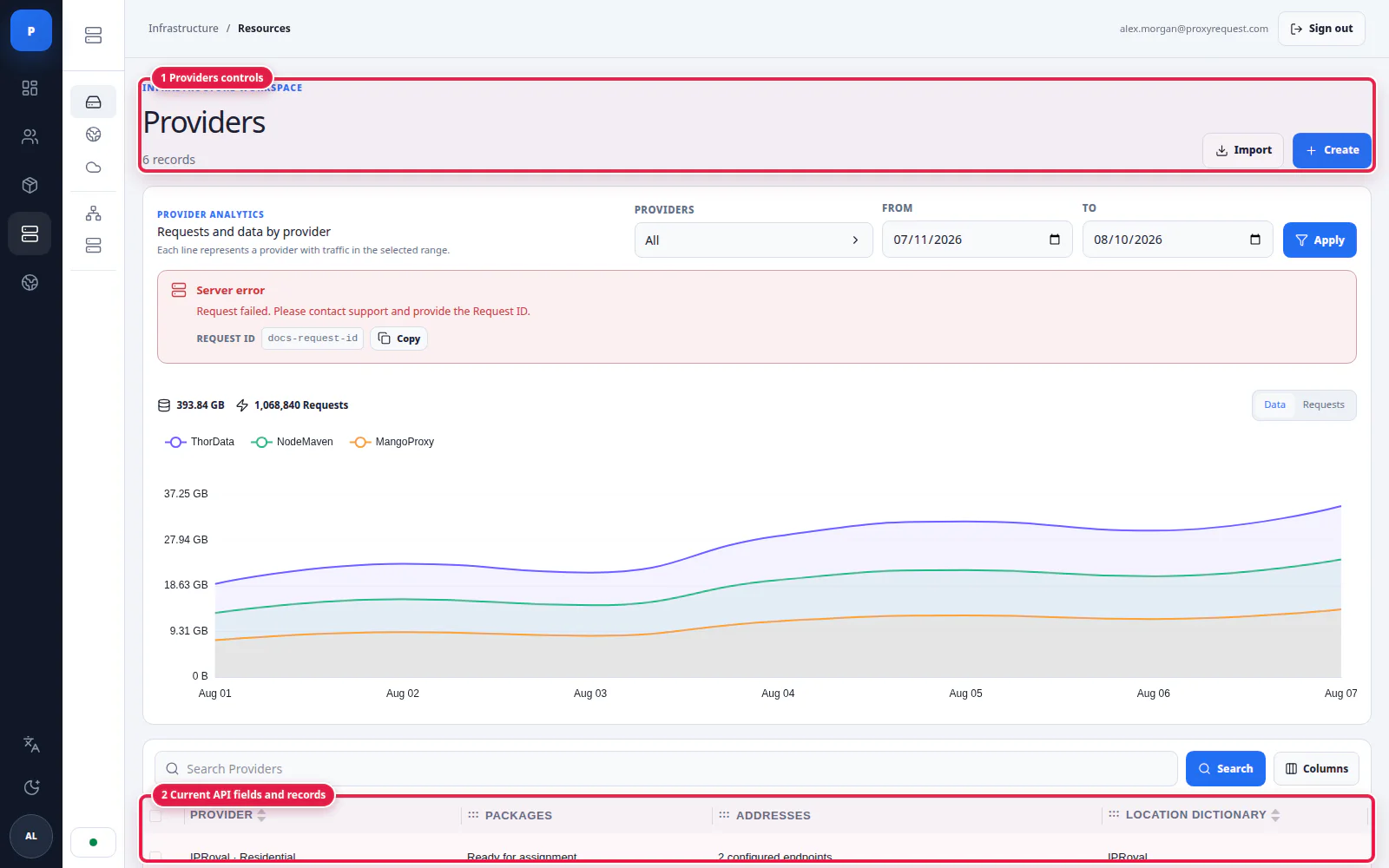
Design the product before the dashboard
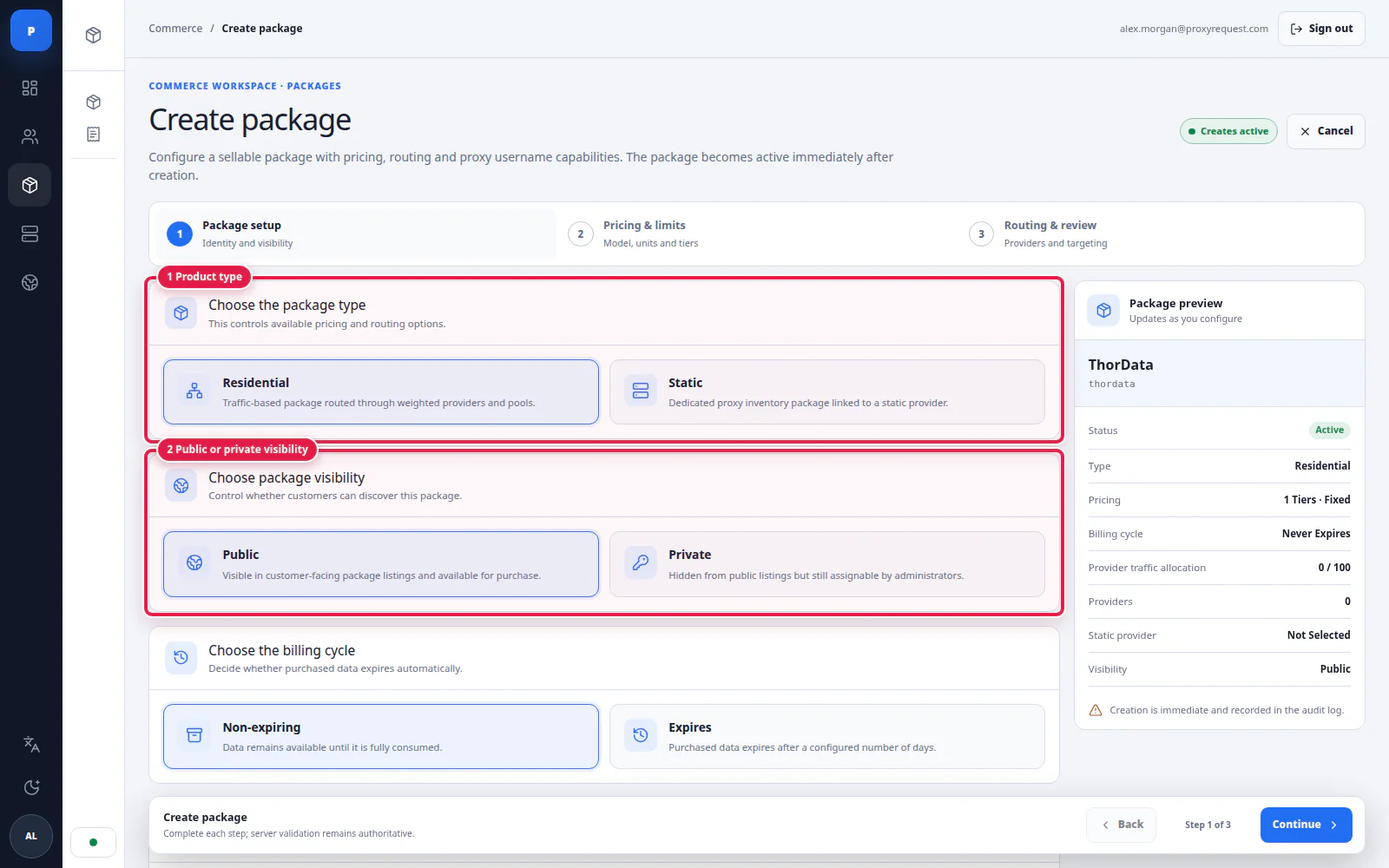
A supplier account is not a customer product. A product needs a clear contract:
- proxy type and eligible upstream pool;
- allowed countries and targeting fields;
- rotation and sticky-session behaviour;
- traffic allowance and renewal rule;
- concurrency or sub-user limits;
- credentials and gateway hostname;
- price, tax, and refund rules;
- support expectations and acceptable use.
Avoid copying the supplier catalog directly. Your product should describe what
your layer can consistently deliver across eligible supply. If Provider A calls
a field state and Provider B calls it region, customers should not learn two
syntaxes. Normalize both into your public product contract.
This also keeps future migrations possible. When a customer buys “US residential traffic with a 30-minute session,” they buy your behaviour. They should not need new credentials because you changed an upstream route.
Prove the complete request path
Before building a storefront, prove one connection from credential to usage. The gateway authenticates the package; routing keeps only routes that satisfy its proxy type and exact target; health removes degraded routes; session policy preserves or deliberately replaces an existing binding; the gateway then records the traffic.
The order matters. A weight cannot make an unsupported country eligible, and failover must not broaden geography or replay application data after delivery is uncertain. Sticky state also has to work across gateway nodes rather than living in one process.
If this path is ambiguous for one product and one provider, a larger catalog will multiply the ambiguity. The multi-provider routing guide covers eligibility, sessions, health, and safe failover in detail.
Make usage accounting a ledger
Bandwidth is money in a proxy business. Counting it after the fact from web server logs is not enough.
The gateway should produce usage data tied to the authenticated customer, package, sub-user, product route, and request. The accounting layer applies that usage to a ledger. A ledger provides an auditable sequence of debits and credits instead of only one mutable balance.
Define which byte directions count and how CONNECT and SOCKS5 streams are measured. Enforce quotas close to the gateway, while documenting the small boundary where a live connection can cross its final allowance. Store enough context to explain who used traffic, through which package, and when.
ProxyRequest’s usage accounting guide covers the gateway-to-ledger flow and sub-user attribution.
Separate customer identity from proxy credentials
An account login and a proxy credential solve different problems. The account login grants dashboard and API access. A proxy credential authenticates at a high-volume network gateway. Keep their lifecycles separate.
Customers should be able to rotate proxy passwords without resetting their dashboard login. Teams may need sub-users or credentials with their own limits. An operator needs to suspend network access immediately while preserving records for billing and support.
A practical access model separates the customer organization, human roles, scoped API keys, proxy credentials, sub-users, and dated package assignments.
Build billing around the ledger
Billing and accounting are related but not identical. Accounting says what was consumed and what allowance remains. Billing creates orders, invoices, payments, renewals, and credits.
Start with a small commercial model you can support. Manual invoicing plus operator-assigned packages may be correct for the first B2B customers. A public self-service checkout adds taxes, payment failures, fraud checks, refunds, renewal jobs, webhook reconciliation, and customer emails. Add it when the sales motion needs it.
Never let a payment webhook directly overwrite a traffic balance without an idempotent order transition. Payment providers retry webhooks. Your handler should recognize the same event and return success without granting the package twice.
Give customers one coherent surface and API
The customer dashboard should explain the product, not expose the database. A useful first version includes:
- active packages and remaining allowance;
- proxy credentials and a connection builder;
- usage over time and by sub-user;
- invoices or order records;
- API keys and webhook configuration where relevant;
- documentation and support entry points.
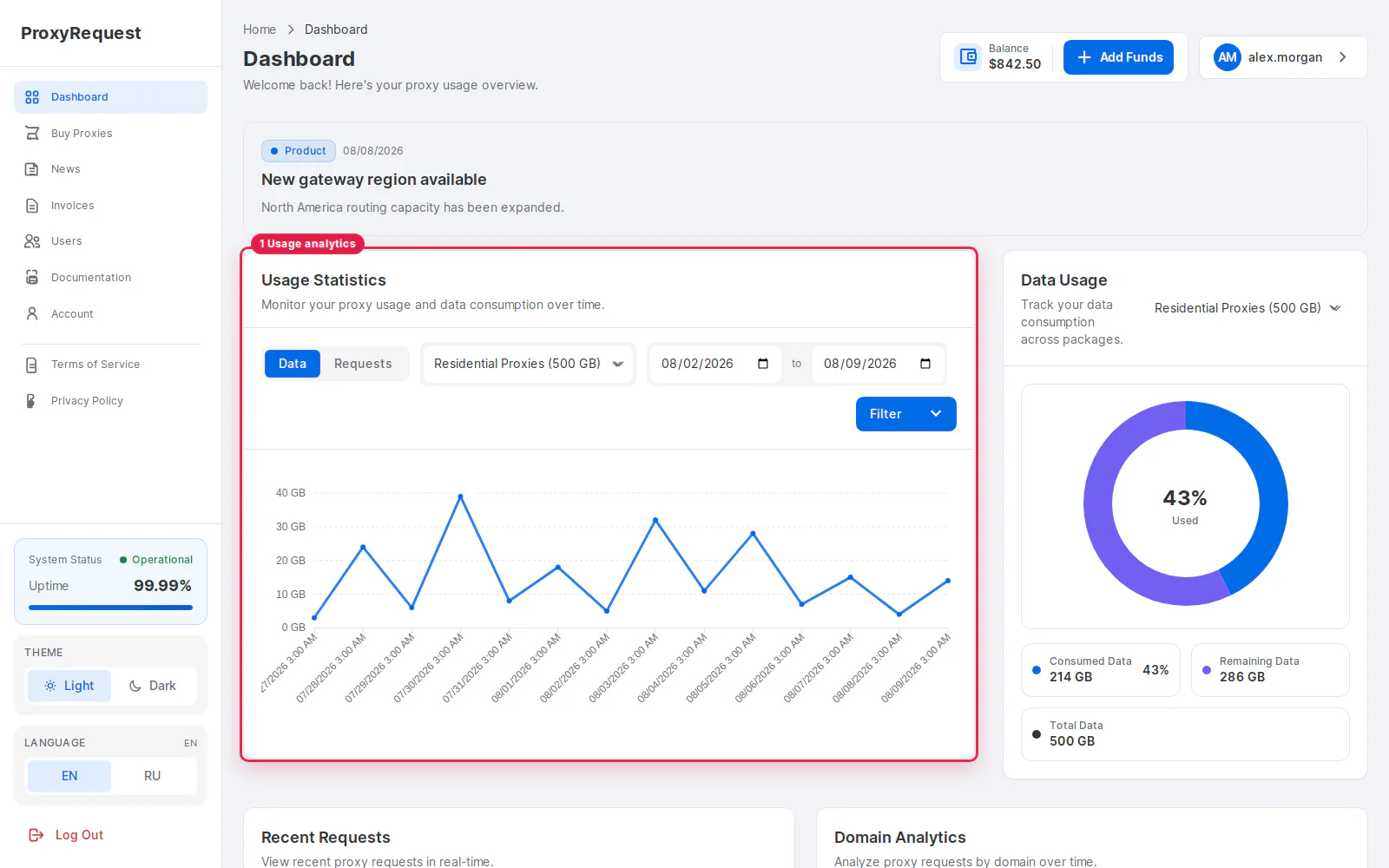
Use your own domain for the dashboard, API, and gateway where the deployment supports it. Expose stable customer operations—products, credentials, usage, sub-users, orders, and webhooks—not database tables or provider-specific IDs. Keep the provider adapter private so a supplier change does not break customer integrations. The white-label proxy software guide covers this abstraction boundary.
Before launch, perform the complete customer path through both dashboard and API: create account, assign package, generate credentials, send traffic, see usage, hit a quota, renew or credit, and revoke access.
Operate the service, not only the servers
Infrastructure is the base, not the finish line. A practical footprint needs gateway capacity, a control-plane API, durable storage, shared state where required, background jobs, metrics, logs, backups, and deployment automation.
Monitor the experience at several layers:
- gateway availability, authentication failures, and resource pressure;
- success and latency by provider and location;
- accounting delay and ledger failures;
- dashboard, API, webhook, and background-job errors;
- expiring supplier balances or credentials.
Alert on customer impact, not every fluctuation. A provider health score should use a useful sample window and recovery threshold; otherwise one failed request can remove capacity and one successful request can restore a broken route.
Backups need restore tests. A green “backup completed” job does not prove that you can recover orders, package assignments, and ledger history.
Prepare support and abuse handling
Proxy services receive operational and acceptable-use questions from the first day. Decide who owns complaints, how a credential is suspended, which records can be inspected, and when an upstream must be contacted.
Publish clear terms and a privacy policy. Collect only the customer and traffic metadata needed for the service, security, support, and legal obligations. Get professional legal advice for the jurisdictions and markets where you operate; software architecture cannot replace it.
Prepare support answers for connection syntax, authentication failures, target availability, sessions, quota exhaustion, and upstream degradation. Helpful errors reduce tickets, but customer-facing errors must not reveal upstream hostnames or credentials.
Model the economics before launch
Revenue is easy to model and cash flow is easy to miss. A customer can pay for a package today while you have already committed to upstream capacity for the month. A supplier can invoice by reported usage while your customer package expires with unused allowance. Payment processors can release funds after you must pay infrastructure bills.
Build a small model by product, not only for the whole company. Include:
- expected sold allowance and expected consumed allowance;
- upstream cost per counted gigabyte in the target mix;
- committed capacity that may remain unused;
- gateway and control-plane infrastructure;
- software, payment, tax, refund, and chargeback costs;
- support, refunds, chargebacks, acquisition, and an incident reserve.
Run a poor-quality scenario. If one route is removed for a week, can the remaining supply carry the product? If you use a more expensive route to preserve quality, does the package still contribute margin? If not, the product is priced for a perfect month rather than a real service.
Keep capacity for concurrency, failover, testing, and provider reporting differences. Start B2B invoicing simply when possible, and automate only after you can reconcile an order, package assignment, ledger entry, payment, credit, and cancellation. A positive bandwidth margin can still consume cash, so model how many paying customers cover fixed platform and operating costs.
Decide whether to build or buy the platform layer
Building gives complete control, but the scope is much larger than a customer panel. You need gateways, provider adapters, routing, authentication, session state, accounting, quotas, products, orders, APIs, dashboards, monitoring, deployment, security work, and ongoing incident response.
Buying a platform reduces the amount your team must create and maintain, but you still own supply contracts, product decisions, payment operations, support, and go-to-market. The right comparison is not “developer salary versus subscription.” It is the capability, time, operational risk, and long-term control of both paths. See our detailed build-versus-buy proxy platform analysis.
ProxyRequest currently starts at $800 per month, with lower effective monthly rates on longer terms. The pricing section shows the current terms.
A realistic launch checklist
Use this as a release gate, not as a list to complete after ads start.
Supply and product
- Resale permission and acceptable-use terms are confirmed.
- Product targeting is a supported intersection, not an optimistic union.
- Supplier costs and reserve margins are documented.
- Product names, allowances, session rules, and limits are unambiguous.
Request path
- HTTP CONNECT and SOCKS5 paths are tested where sold.
- Authentication, invalid targeting, quota exhaustion, and upstream failure return safe errors.
- Health filtering happens before weight selection.
- Sticky sessions behave consistently across gateway nodes.
- Failover does not broaden geography or replay unsafe requests.
Accounting and commerce
- Usage is attributed to the correct customer, package, and sub-user.
- Concurrent traffic near a hard quota is tested.
- Orders and payment callbacks are idempotent.
- Operators can issue a traceable credit or correction.
- The dashboard total can be reconciled with the ledger.
Customer experience
- A new customer can reach working credentials without private instructions.
- The dashboard, API, gateway, emails, and docs use your brand.
- No upstream hostname, header, error, or support output leaks.
- Contact, terms, privacy, and acceptable-use pages are present.
Operations
- Metrics and customer-impact alerts are active.
- Backups have been restored in a test environment.
- On-call ownership and escalation paths are written down.
- Provider degradation and full provider outage have been rehearsed.
- A small controlled customer cohort has completed the full lifecycle.
Start narrow. One reliable product with exact behaviour is more valuable than a large catalog held together by exceptions. Once the request path and ledger are trustworthy, adding supply and products becomes controlled work instead of a new architecture each time.