01 / Expand
Add a product to your existing platform
Keep your interface, checkout and customer accounts. Use the API to add residential, ISP or datacenter access with provisioning and usage accounting.
White-label platform & API
Launch your own proxy website with the included backend and branded dashboard, or quickly integrate proxy functionality into your existing system through the API. Support residential, ISP and datacenter products while keeping control of your brand, pricing and customers.
For standard integrations with supported upstream providers and a ready integration team. Production rollout also depends on your interface, billing workflows and acceptance checks.
Choose your starting point
01 / Expand
Keep your interface, checkout and customer accounts. Use the API to add residential, ISP or datacenter access with provisioning and usage accounting.
02 / Launch
Use the included backend and branded customer dashboard to publish your proxy products, manage accounts and handle commercial workflows.
The operating model
ProxyRequest standardizes your upstream supply, applies product rules and accounts for usage. Connect that backend to your existing platform through the API, or use the included branded dashboard.
Standard deployment boundary
Every plan includes two managed gateway VPS instances. Choose EU, US, or Asia. Larger footprints, private integrations, and customer-provided infrastructure are scoped separately.
Who uses what
Use the supplied interfaces to operate and sell your proxy products. Headless integration keeps your existing UI, customer identity, checkout and billing in place.
Shared data backbone: both surfaces use the same users, packages, orders, proxy services, and usage records. Headless deployments expose that product layer through the API.
Build versus buy
A production proxy product spans routing, accounting, customer workflows, releases, monitoring, and on-call support. ProxyRequest supplies the maintained product layer while you keep control of supply and pricing.
Illustrative monthly model
Illustrative comparison based on 2–3 developers at $3,000–$8,000 each per month. Recruiting, QA, DevOps, payroll overhead, and opportunity cost are not included.
One connected product
Explore the included admin and customer dashboards. You can use the supplied customer interface or keep your own UI through a headless integration.
Operator interface / 01
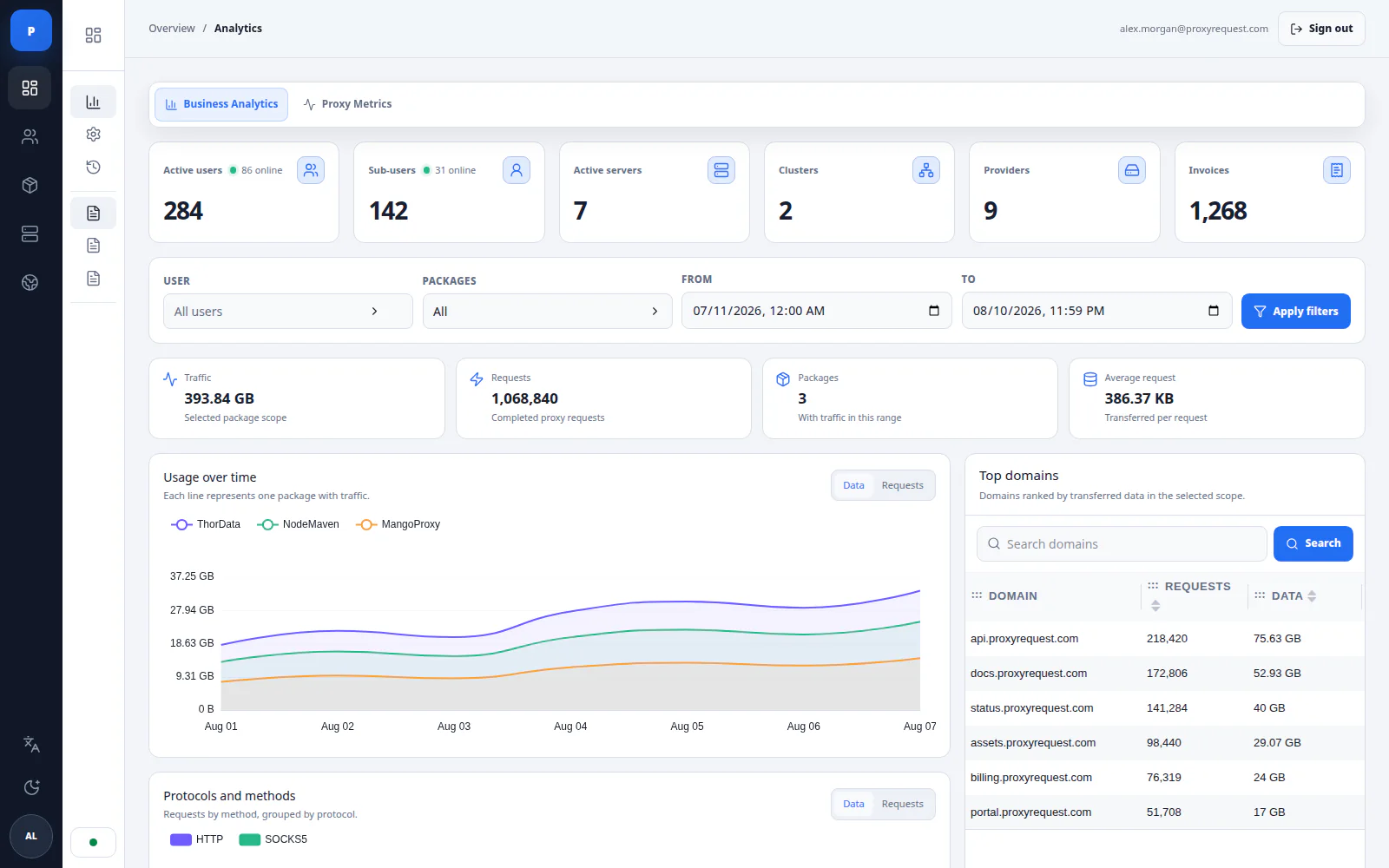
Read sales, purchased and consumed traffic, and average order value in one clear seven-day view.
Operator interface / 02
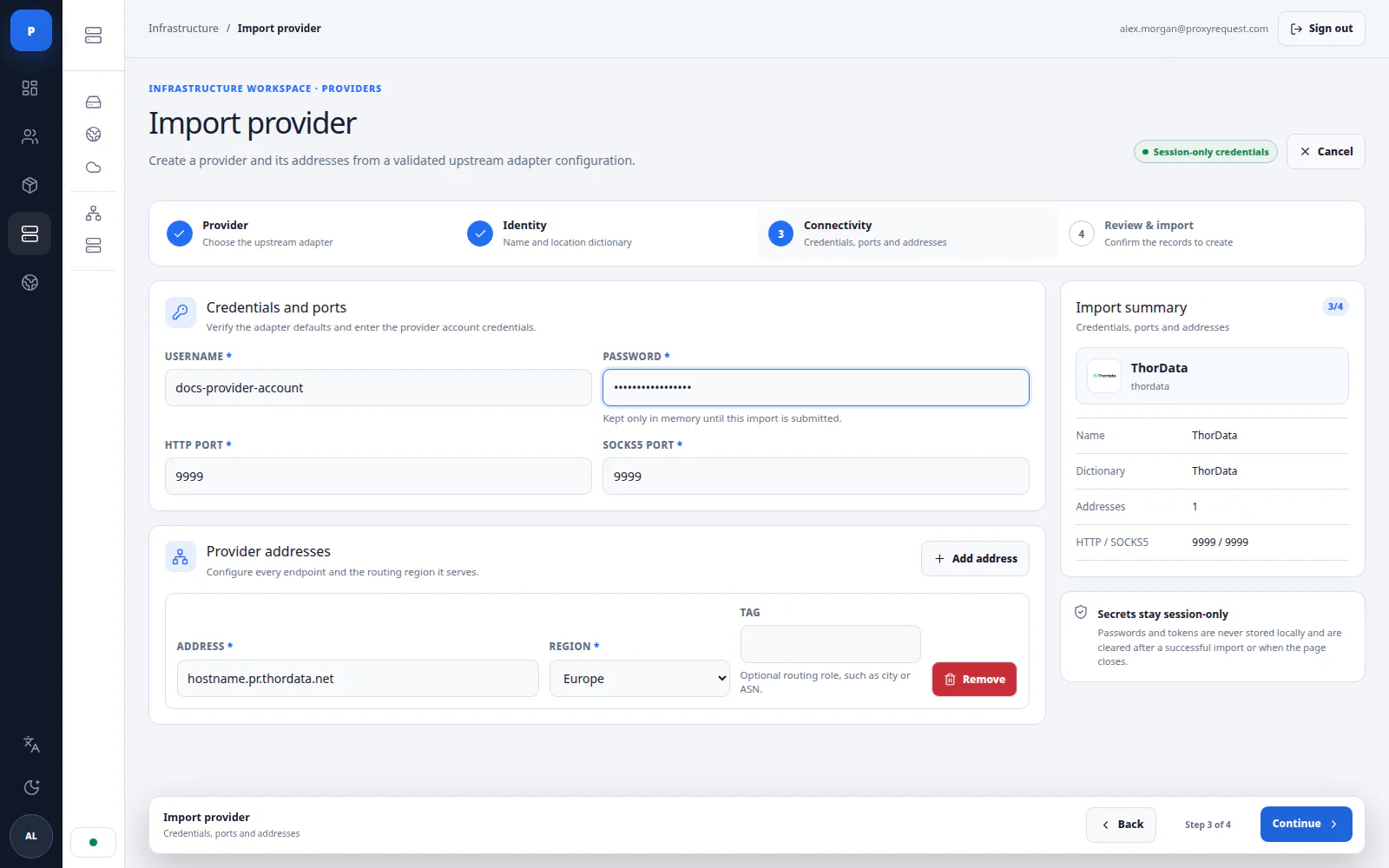
Choose ready-made settings, then review identity, credentials, endpoints, and access rules in a guided setup.
Operator interface / 03
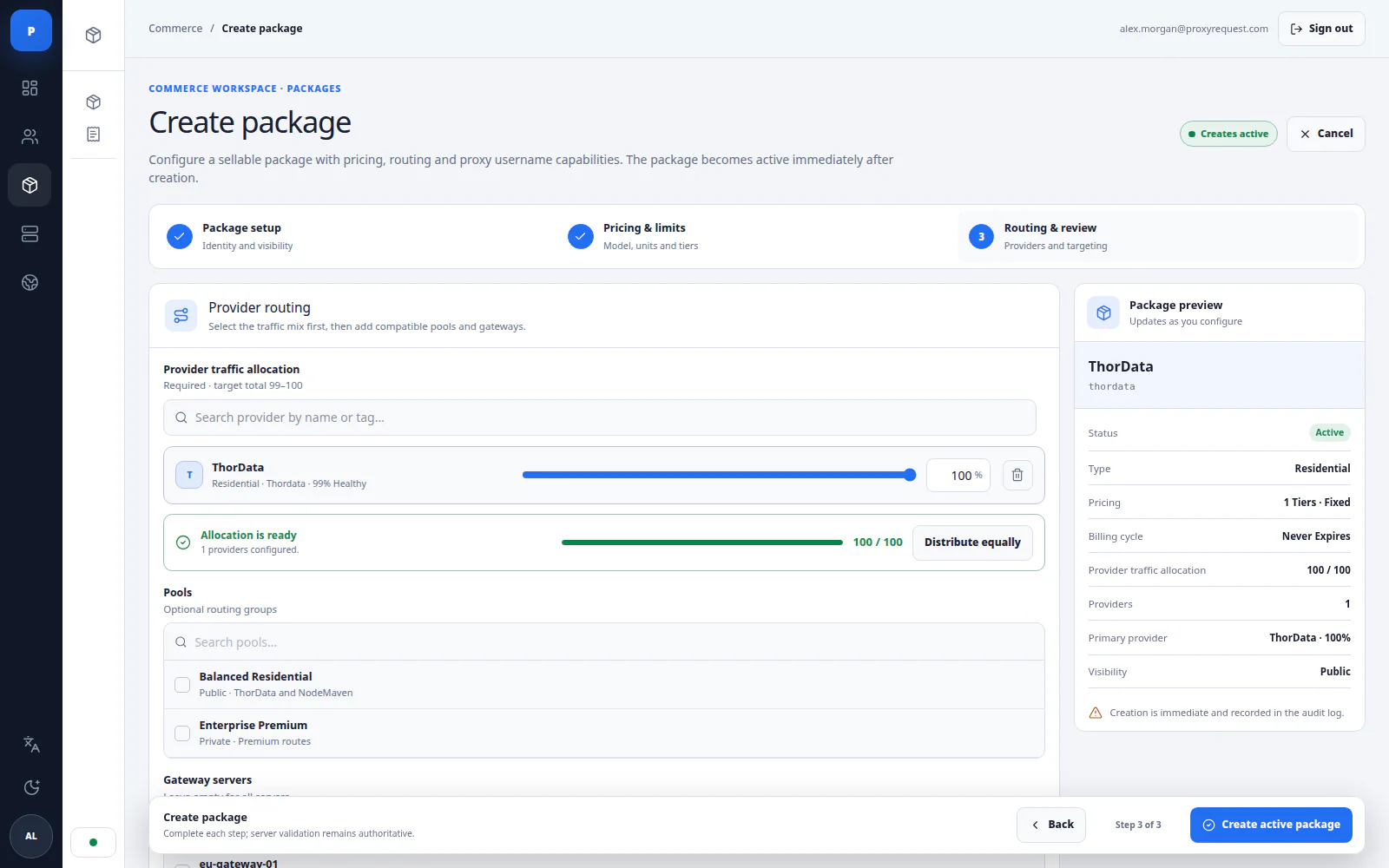
See how a customer request moves through gateway and provider selection, then tune the package's traffic sources.
Operator interface / 04
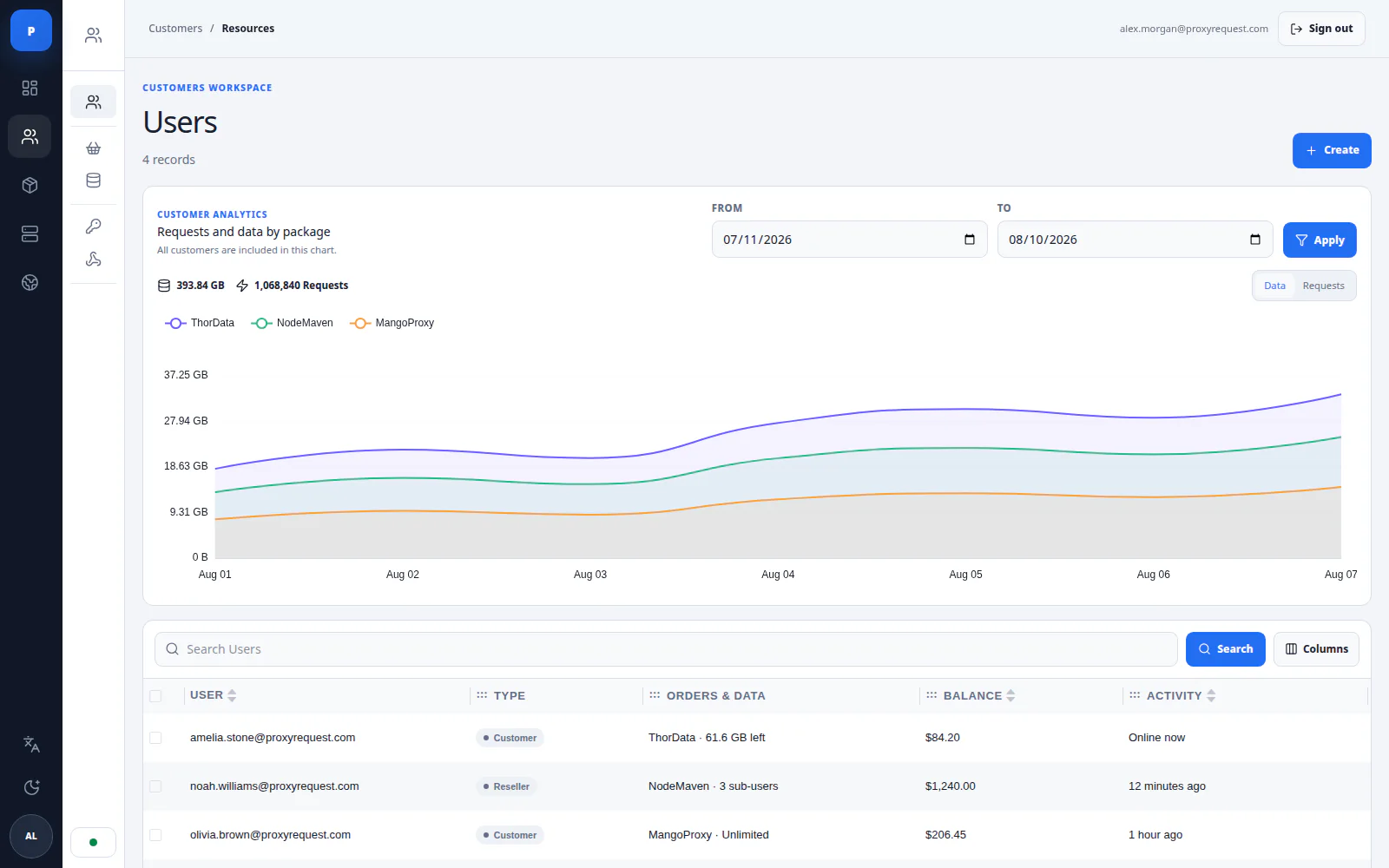
Find customer accounts, review activity, and open the controls for balances, packages, limits, and sub-users.
Customer interface / 01
Give customers a complete sign-in and account experience with your base brand styling on every plan.

Customer interface / 02
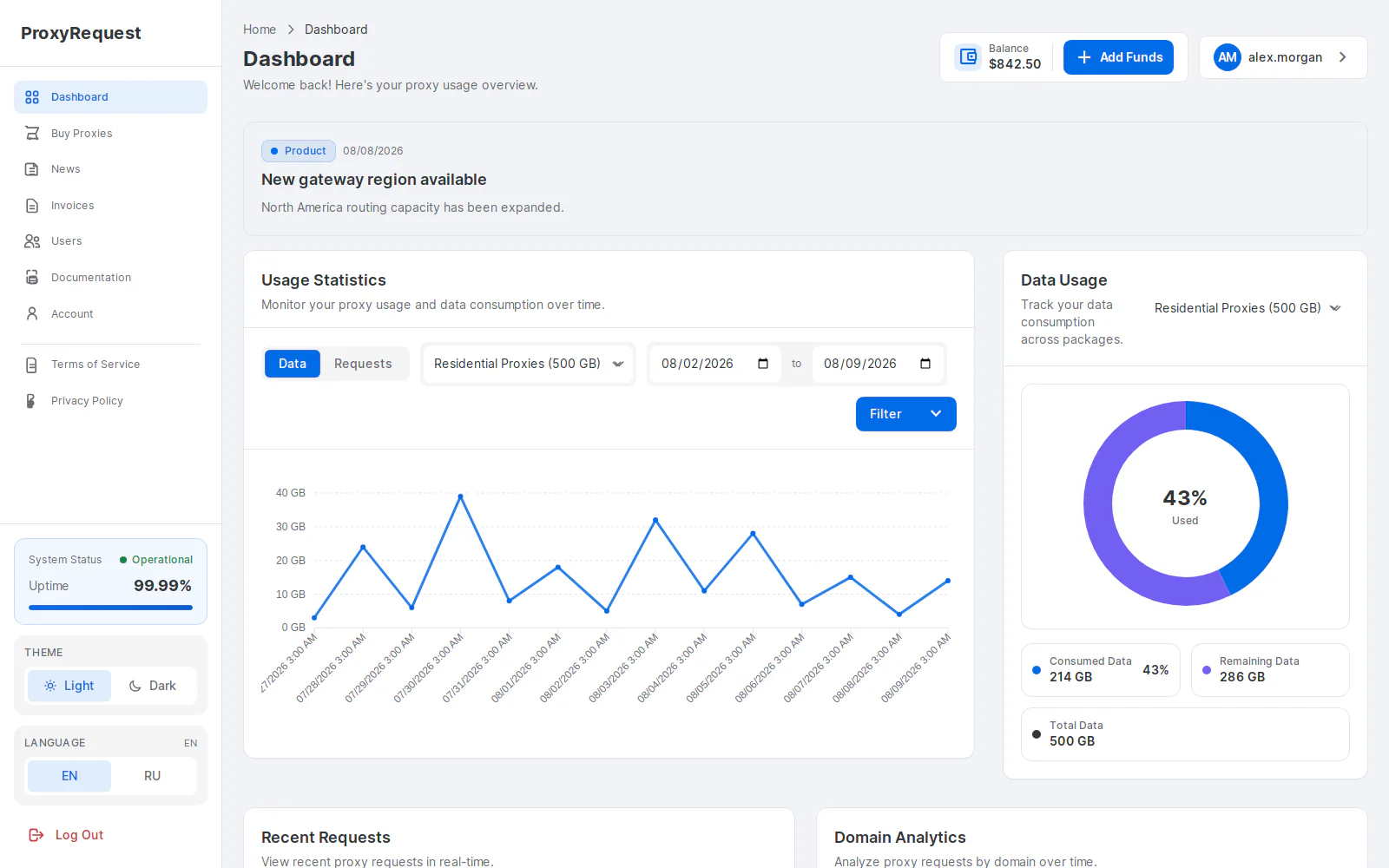
Customers can review traffic, requests, package consumption, account balance, and service status in one place.
Customer interface / 03
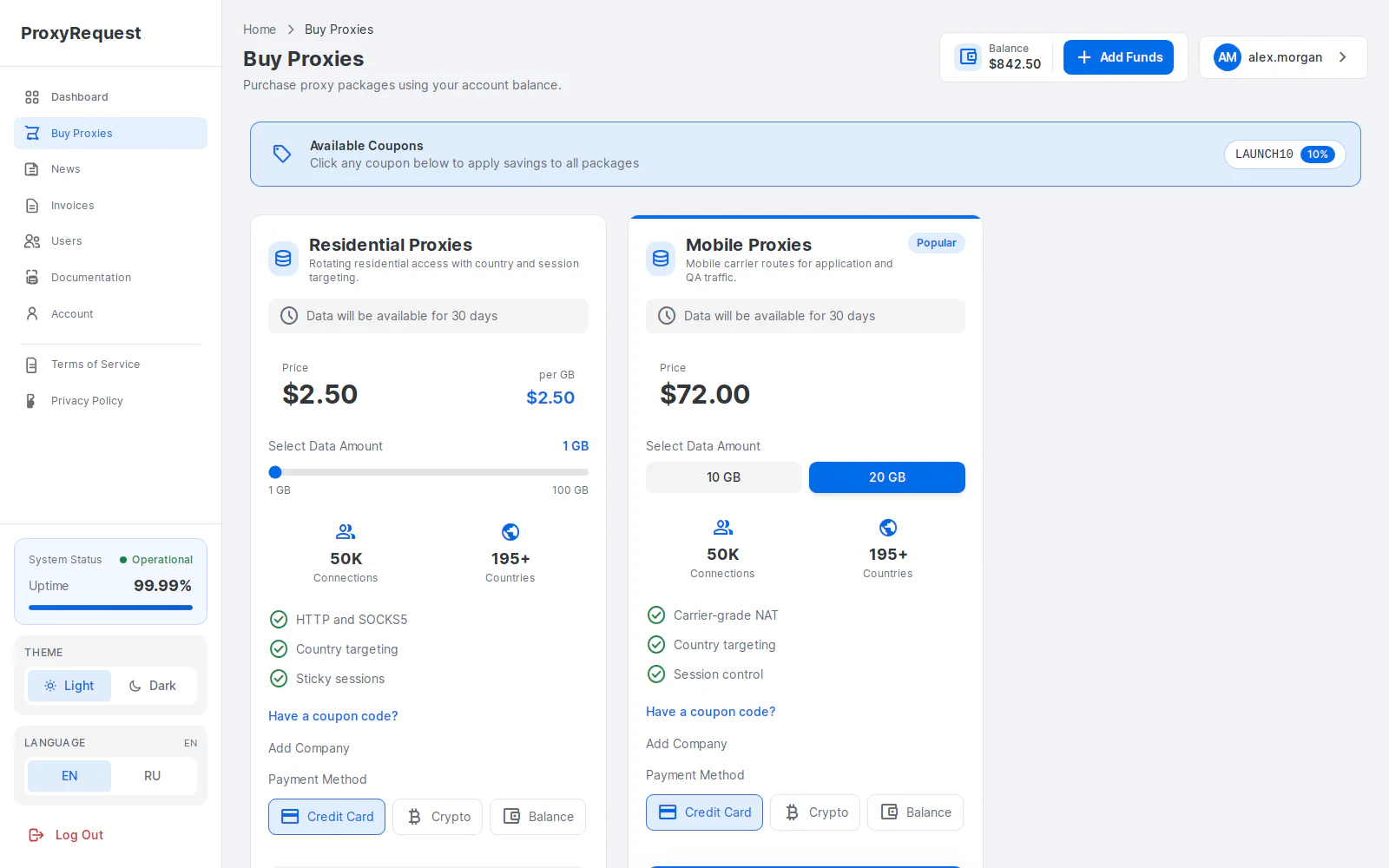
Publish proxy packages, allowances, billing periods, features, pricing, and coupons through the same backend catalog.
Customer interface / 04
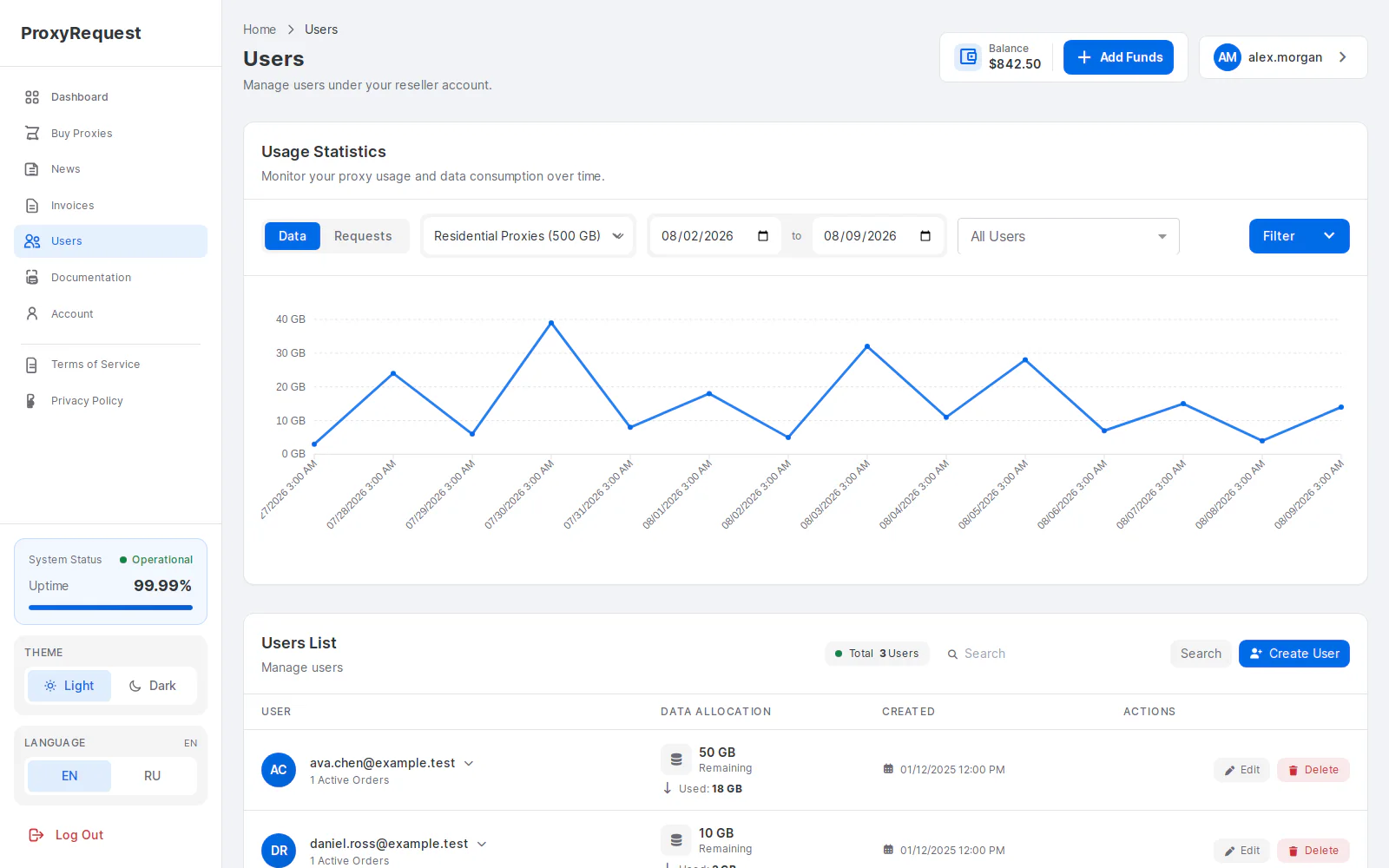
Resellers can create accounts, allocate packages, inspect usage, and issue credentials without another tool.
Upstream integrations / 14 presets
Prefill connection and targeting defaults, add your own credentials, review the mapping, and validate the provider through a guided import.














Platform coverage
Choose the complete white-label product or keep your existing frontend and connect the same routing and accounting engine through the API.
01 / Provider control
Pools, weights, locations, sessions, gateway scope, and failure behavior behind stable endpoints.
02 / Customer operations
Accounts, packages, credentials, balances, reseller users, limits, and lifecycle workflows.
03 / Usage visibility
Per-user ledgers, request records, run-out behavior, and connection policies.
04 / Branded sales
Package catalog, orders, invoices, billing workflows, API access, and base brand styling.
05 / Automation
REST API, webhooks, node deployment, monitoring, software updates, and platform maintenance.
Use the maintained proxy backend and the included customer-facing product: authentication, catalog, purchasing, invoices, proxy delivery, analytics, reseller tools, and base brand styling.
You want to launch or replace the complete operator and customer experience without maintaining either interface.
You own supply, brand, pricing, and customers. ProxyRequest operates the connected software and gateway layer.
Your control plane remains authoritative for UI, users, payments, subscriptions, and billing. ProxyRequest handles routing, provisioning, accounting, analytics, and webhooks.
Your existing UI, user model, payments, and subscriptions already work and should remain authoritative.
Your application orchestrates commercial workflows through the REST API while webhooks return platform events.
Headless infrastructure for your workloads
Headless use case
Connect price, stock, and catalogue crawlers to your providers. Account for collection traffic by project and market.
Explore the workloadHeadless use case
Keep your browser runtime and orchestration. Configure proxy routing, session settings, tenant access, and usage limits.
Explore the workloadFit check
The platform is a strong fit when proxy supply is an input to your business. It is not a storefront for purchasing traffic from ProxyRequest.
Need a non-standard deployment? Larger gateway footprints, private provider integrations, and customer-provided infrastructure can be scoped separately.
Transparent software pricing
You contract upstream traffic directly. No revenue share, bandwidth markup, per-user fee, or provider markup.
View production case studiesProxyRequest Platform
Included in the software fee
Not included: upstream bandwidth and provider invoices. Expanded gateway capacity, private integrations, customer-provided infrastructure, and unique workflows are scoped separately.
Clear operating boundary
Answers about product ownership, upstream supply, pricing boundaries, deployment, launch, and headless integration.
Explore documentationNo. ProxyRequest provides the software, routing, accounting, dashboard, API, and managed gateway layer used to operate your own proxy products. Upstream supply remains contracted and paid for by you.
Yes. ProxyRequest is the control and product layer. You continue to choose and pay for the upstream supply used by your products; the standard gateway infrastructure is included and managed by ProxyRequest.
You do. You define the provider mix, packages, pricing, limits, brand, domain, and customer relationships. ProxyRequest does not take a revenue share or add a bandwidth, provider, or per-user markup.
Yes. Products can use different provider mixes, routing policies, geography, session behavior, credentials, and limits.
Yes. Keep your dashboard, customer identity, checkout and billing workflows. Connect your application to the ProxyRequest API for access provisioning, routing and usage accounting. The included customer dashboard is optional for headless integrations.
Full Platform includes the connected operator and customer interfaces. In Headless mode your existing control plane remains authoritative for UI, users, payments, subscriptions, and billing while the REST API and webhooks connect it to ProxyRequest routing, provisioning, accounting, and analytics.
Yes. Every plan includes the customer dashboard with base brand styling, connected to the same users, packages, orders, usage records, and proxy services as the backend.
The maintained platform includes the operator and customer dashboards, routing, usage accounting, REST API and webhooks, base brand styling, and two managed gateway VPS instances. Upstream bandwidth and provider invoices remain separate.
No. Every plan includes two managed gateway VPS instances. Choose any combination of EU, US, or Asia; additional capacity and customer-provided infrastructure are scoped separately.
Yes. Provider pools, weights, locations, and failure behavior sit behind stable customer endpoints, so supply can change without exposing upstream-specific configuration to customers.
A standard setup can reach a first working integration in 1–3 days when supported upstream providers, access credentials and your integration team are ready. This means provisioning access, making a successful proxy request and verifying usage accounting. Production rollout may take longer when your interface, billing workflows or custom requirements need additional work.