The first version of a proxy reseller platform can look small: a gateway, a user table, and a dashboard with a bandwidth balance. The production version is a distributed network service connected to a commercial control plane.
That difference should drive the build-versus-buy decision. Do not compare a software subscription with the time needed to draw the first panel. Compare the complete capability, delivery time, ongoing ownership, and failure risk.
This article uses the same scope we discuss when an operator considers replacing scripts or starting an internal build. The numbers are illustrative, not a quote for every company.
Define “proxy platform” before estimating it
A platform has at least four planes:
- Data plane: HTTP/SOCKS5 gateways, authentication, upstream connectivity, traffic streaming, and counters.
- Decision plane: product eligibility, pools, weights, health, sessions, limits, and failure policy.
- Commercial control plane: customers, packages, orders, ledger, billing, API, webhooks, and dashboards.
- Operations plane: deployment, secrets, metrics, logs, alerts, backups, migrations, and support diagnostics.
If your estimate contains “proxy server + admin template,” it does not yet describe a sellable service.
The systems you must build internally
A serious estimate needs seven workstreams:
- Network path: HTTP/SOCKS5 gateways, authentication, connection lifecycle, traffic counters, safe errors, and graceful releases.
- Supply integration: maintained provider adapters, normalized targeting, endpoint selection, secret handling, and error mapping.
- Routing state: product eligibility, route health, weights, sticky sessions, exact-target failover, and consistent decisions across gateway nodes.
- Accounting and commerce: durable usage events, ledger, quotas, packages, orders, invoices, renewals, credits, and idempotent payment callbacks.
- Customer and operator products: two distinct interfaces, roles, API keys, public API, webhooks, diagnostics, and audit history.
- Operations: deployment, schema migrations, capacity, metrics, logs, alerts, backups, and incident tooling.
- Security and recovery: credential storage, abuse controls, access review, dependency updates, tested restore procedures, and incident response.
These workstreams are coupled. Usage collection cannot block live traffic, yet quota enforcement cannot wait for a nightly report. A sticky session cannot live only in one gateway process, and a provider error cannot be passed straight to a customer if it contains private account details.
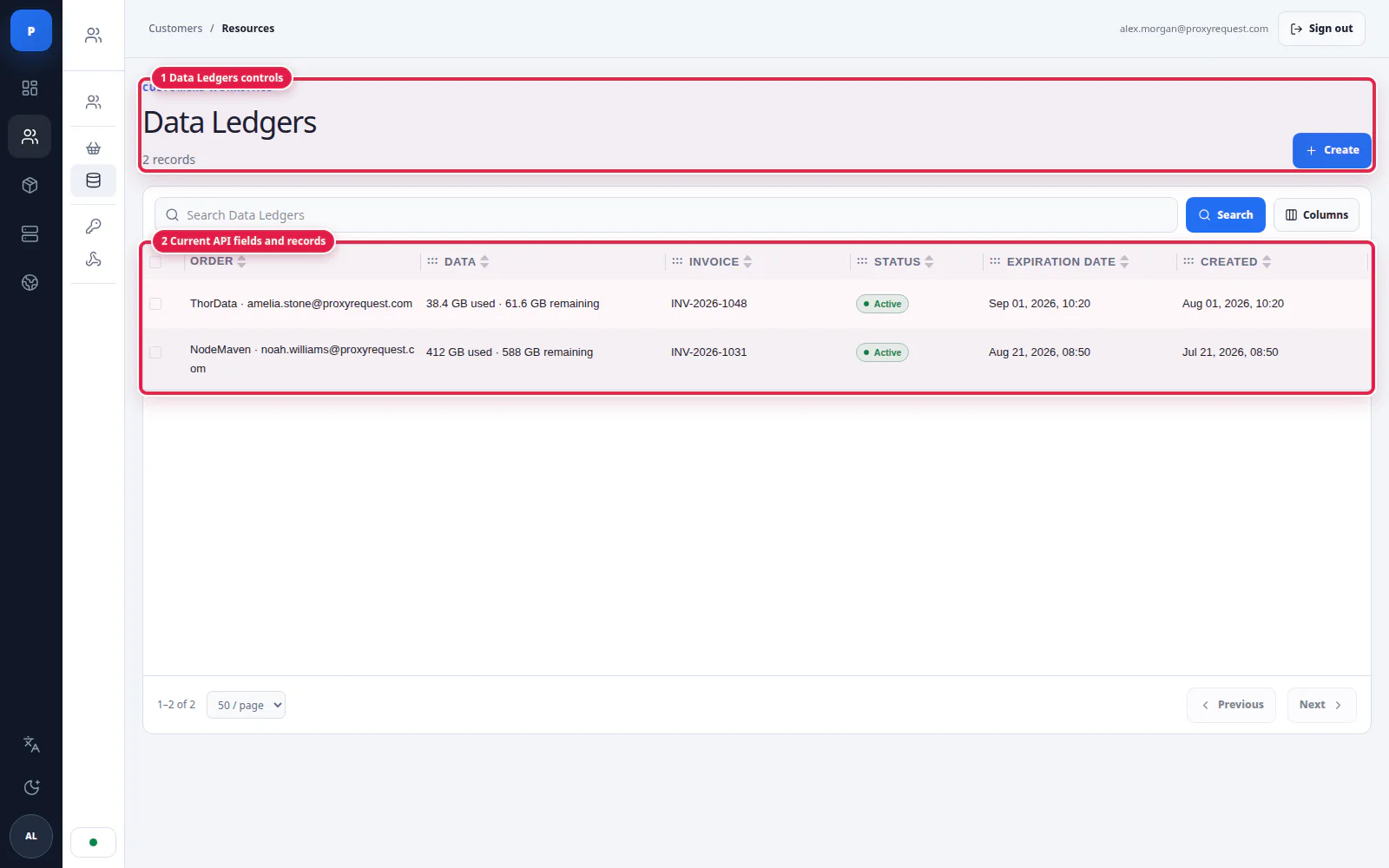
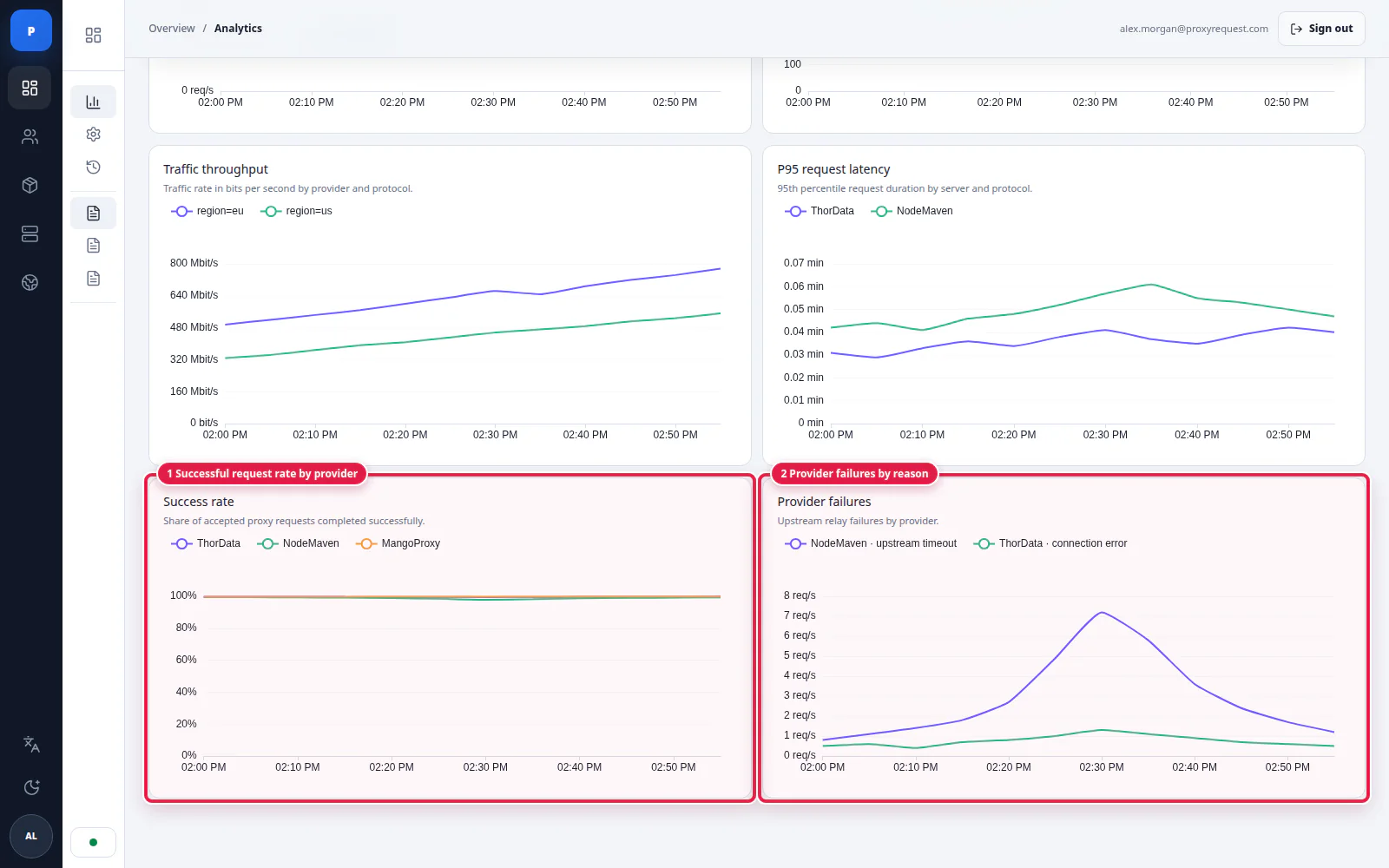
For a field-by-field evaluation of these capabilities, use the proxy reseller software checklist. The build-versus-buy model below focuses on the people, time, and ownership required to deliver them.
What an internal team really looks like
One strong backend engineer can build a proof of concept. A dependable product usually needs several skills, whether held by employees, contractors, or the same small team wearing several hats:
- network/backend engineering for gateways and routing;
- backend product engineering for APIs, ledger, orders, and jobs;
- frontend engineering for operator and customer workflows;
- infrastructure and reliability engineering;
- security review and ongoing maintenance;
- product design, testing, documentation, and support input.
A small team can cover this. The risk is not the title count; it is hidden work and single-person knowledge. If only one engineer understands accounting recovery and provider routing, normal leave becomes operational risk.
A realistic time model
For an experienced team using familiar technology, a constrained single-provider minimum product may take several months. A multi-provider platform with hardened gateways, ledger, customer and operator interfaces, API, deployment, and migration often takes longer.
Do not estimate every subsystem sequentially and add the days. Integration and stabilization dominate near launch. Routing affects sessions; sessions affect support; gateway counters affect the ledger; the ledger affects limits, invoices, analytics, and customer trust.
Plan stages:
- architecture and product contract;
- one vertical request-to-ledger slice;
- operator and customer workflows;
- additional provider/protocol capability;
- failure, concurrency, and migration testing;
- controlled production cohort;
- operational hardening based on real traffic.
Skipping stages does not remove them. It moves them into customer incidents.
Illustrative cost model
Use local compensation and your actual staffing model. The following example is only a worksheet.
Assume a lean internal effort averages 2.5 engineering equivalents for six months, including backend/network, frontend, and infrastructure work. At a fully loaded cost of $6,000–$12,000 per engineer-month, initial labour is roughly $90,000–$180,000. Add design, security review, infrastructure, management time, and the opportunity cost of features those engineers did not build elsewhere.
After launch, assume 0.5–1.5 engineering equivalents for upgrades, upstream changes, incidents, customer needs, and new product work. The range varies widely with traffic, customization, and reliability expectations.
These figures should not be presented as universal market prices. Replace them with your own salary, contractor, tax, and overhead data. Their purpose is to make maintenance visible.
ProxyRequest’s current software price starts at $800 per month, $700 per month on a six-month term, or $600 per month on an annual term. See the current pricing and scope. Supply, payment processing, your external infrastructure, and separately scoped customization remain costs in either model.
Costs that exist in both paths
Buying software does not eliminate the business. Both paths still need:
- upstream bandwidth and commitments;
- gateway and platform infrastructure where applicable;
- payment fees and chargeback handling;
- domains, email, and legal documents;
- customer support and abuse response;
- monitoring ownership and incident decisions;
- supplier quality management;
- sales and marketing.
Compare only the layers the vendor actually provides. A low subscription for a panel without gateways, routing, and accounting is not comparable to a managed operational platform.
Where building wins
Build internally when the platform itself creates defensible value and you can sustain the team. Strong reasons include:
- a routing or network model unsupported by available software;
- very high scale where platform economics materially change;
- regulatory or deployment constraints requiring full control;
- deep integration with a larger product that cannot use stable external APIs;
- an engineering organization already experienced with network data planes and accounting systems;
- a long-term strategy to sell or license the platform technology itself.
“We can start with a script” is not a strong reason. “Our product requires a provable routing primitive no platform supports” can be.
Where buying wins
Buy when speed and operational completeness matter more than owning every line of code. Common signals are:
- you already have supply and customers waiting;
- engineering should focus on acquisition, special integrations, or a different core product;
- multi-provider routing and accounting are requirements, not differentiators;
- you need a stable migration path from manual operations;
- a predictable platform cost fits the commercial model;
- the vendor can show the full request, usage, and recovery flows.
The hybrid option
Build versus buy is not always binary. An operator can use managed gateways and control-plane software while keeping its own storefront or orchestration layer. A stable API can connect customer provisioning, orders, usage, and webhooks to existing systems.
The hybrid model needs clear system-of-record ownership. Decide which system owns customer identity, package assignment, payment state, and accounting. Duplicate writable records create reconciliation failures.
ProxyRequest documents hybrid and headless integration for teams that keep a separate customer or commercial layer.
Compare lock-in honestly on both sides
Buying creates vendor dependency. Building creates dependency on your own code, people, and historical decisions. Both can become lock-in.
For a vendor platform, reduce risk with stable public domains, documented APIs, data exports, explicit backup ownership, a termination process, and mappings that do not expose vendor IDs to customers. Ask how long exports remain available and whether gateway configuration can be migrated without changing every credential.
For an internal build, reduce risk with architecture records, runbooks, test coverage, reproducible environments, dependency maintenance, and more than one person able to recover the request-to-ledger path. Source code in your repository is not sufficient if nobody can deploy it or explain a quota discrepancy.
Estimate the cost of changing direction after two years. Which customer-facing interfaces remain stable? Which records can be reconstructed? Which secrets and domains do you control? A slightly slower initial choice may be valuable when it leaves a clean exit boundary.
Use these answers in the commercial decision. “No vendor lock-in” is not credible when the product depends on undocumented internal behaviour, and “managed” is not credible when you cannot obtain your own customer and ledger records.
Due diligence on either path
- Assign an owner for the complete request-to-ledger path, whether that owner is your team or the vendor.
- Run real HTTP and SOCKS5 traffic through authentication, routing, session, and accounting; then test exhausted quota and degraded supply.
- Inspect the customer result and the operator evidence for the same failure.
- Write public product semantics before schema and endpoint design.
- Review data ownership, exports, backups, upgrades, security response, and exit terms.
- Put branding, onboarding, custom integrations, and separately priced work in writing.
- Budget for stabilization, maintenance, and the roadmap work displaced by the decision.
The best decision is the one that treats software as a continuing operational system. For the underlying capability list, read what proxy reseller software actually needs. For the routing complexity that appears after the second supplier, continue to the multi-provider guide.