“White-label proxies” is used for two different products.
The first is a provider-backed white label: a proxy provider gives you its traffic and tools to resell that traffic under your brand. The second is independent white-label proxy software: you choose the suppliers and use a platform to create your own products, gateway, customer access, usage model, and brand.
Both can be legitimate. They solve different problems, create different dependencies, and give the operator a different amount of control. Confusing them makes vendor comparisons almost useless.
In ProxyRequest deployments, we treat the public gateway, credentials, product names, and customer records as the operator’s contract. Provider records remain inside the operational boundary.
A precise definition
White-label proxy software is the product and operational layer that lets an operator sell proxy access under its own identity. A serious implementation can cover:
- branded customer and operator interfaces;
- custom domains for the dashboard, API, and proxy gateways;
- products assembled from operator-selected upstream supply;
- unified customer credentials and targeting syntax;
- routing, session affinity, health controls, and failover;
- package limits and usage accounting;
- orders, billing integration, APIs, and webhooks;
- customer-safe errors, analytics, and documentation.
The word “white-label” describes the customer-facing result. The architectural question is who owns the layers beneath it.
Model one: provider-backed white label
In this model, the provider supplies the network and usually the operational API. It may also supply a customizable panel, generated storefront, or reseller account. You set a retail price or buy at a discount and sell access onward.
Advantages are speed and a smaller technical footprint. There is one supply relationship, one integration, and usually less infrastructure to operate. It can work well when you trust the provider’s coverage and expect your catalog to remain close to its catalog.
The trade-off is concentration. The provider controls available proxy types, countries, targeting, cost changes, maintenance windows, error semantics, and often the credential format. Adding another supplier may be impossible or may require a separate customer product. If the reseller tooling changes, your customer workflow changes with it.
Before signing, confirm:
- explicit resale permission and restrictions;
- whether the customer sees provider hostnames or support material;
- which domains and interface elements can be branded;
- whether customer and order data can be exported;
- the margin or wholesale price rules;
- what happens to customers if the reseller agreement ends;
- API limits and compatibility commitments.
Model two: independent white-label software
Independent software sits above your supply contracts. The operator configures one or more upstream providers or controlled pools. The platform normalizes them into one product and customer model.
This creates a different relationship:
Provider A ─┐Provider B ─┼─> your routing and product layer ─> your customersStatic pool ┘The software does not create proxy supply. It gives existing supply a stable commercial and technical surface. You remain responsible for supplier contracts, costs, acceptable use, and supply quality.
The main advantage is control. You can replace or rebalance a supplier without changing the public gateway. You can define products around customer needs rather than a single provider catalog. You own the customer relationship, pricing, and integration boundary.
The trade-off is operational responsibility. Someone must understand routing, health, accounting, capacity, support, and deployment. A managed platform can reduce engineering work, but it cannot make product decisions for you.
What customers should see
A customer should see one coherent proxy service:
- your company and product names;
- your dashboard domain;
- your proxy gateway hostname;
- one credential and targeting grammar;
- package allowance and usage in your units;
- your API and documentation;
- errors that explain the action without exposing suppliers;
- your support channel and commercial documents.
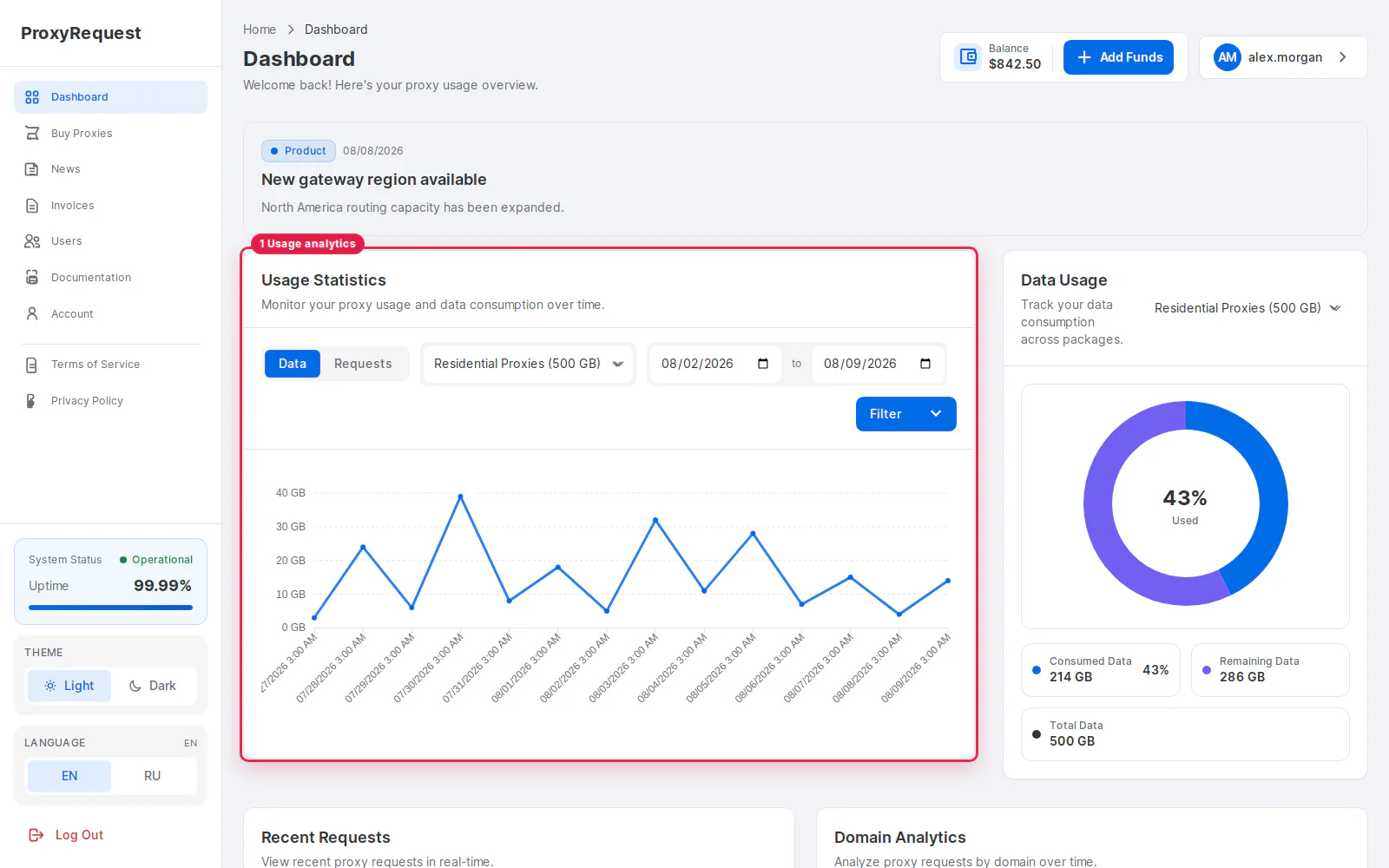
The interface does not need to hide the fact that proxy traffic uses a network of resources. It does need to avoid accidental disclosure that bypasses your product and customer relationship.
What operators must still see
Supplier concealment must never blind the operator. Trusted staff need provider identity, endpoint, route, health, latency, errors, capacity, and accounting context. Without this information, they cannot answer why a country degraded or why costs changed.
This produces two views of the same request:
| Customer view | Operator view |
|---|---|
| Product and requested country | Package, pool, selected route, adapter |
| Public gateway | Gateway node and upstream endpoint |
| Customer-safe error | Normalized and raw internal error category |
| Package usage | Ledger entry plus provider and infrastructure dimensions |
| Public session key | Internal binding and expiration |
The public API must follow the customer view. Raw upstream details belong in a protected operator API and diagnostic interface.
Branding is a system, not a logo upload
A logo and accent color are useful, but customers experience the brand at every boundary. Review:
- domains, TLS certificates, and DNS names;
- login, password recovery, and account emails;
- dashboard navigation and product terminology;
- invoice sender and legal entity;
- API base URL, examples, and generated SDK snippets;
- proxy credential builder and copy buttons;
- gateway error pages or messages;
- status and support links;
- terms, privacy, and acceptable-use documents.
Some items may require separate implementation or commercial services. Ask a vendor what is included, what is configurable, and what is custom work. “Fully white-label” without a written boundary is not a useful promise.
The upstream abstraction boundary
Provider abstraction has four practical tests:
- Connectivity: customers reach your gateway; private adapters connect to the selected upstream.
- Targeting: your public fields are validated, then translated into supported provider formats.
- Errors: customers receive a stable taxonomy while raw provider context stays in protected diagnostics.
- Accounting: customer balances follow documented gateway accounting; provider reports remain a separate cost-reconciliation input.
Failing any one test leaves provider behaviour in the customer contract.
How supplier details leak
Leaks rarely come from one obvious setting. Review the full request and support path:
- proxy gateway DNS and reverse DNS;
- TLS certificates and redirects;
- HTTP headers inserted by an upstream;
- raw authentication challenges;
- error text and status pages;
- credential examples copied from a provider panel;
- API payloads and internal IDs;
- dashboard network requests;
- screenshots, logs, and support replies;
- monitoring links shared with a customer.
A proper gateway can remove or normalize protocol-level details, but process matters too. A support engineer can reveal a supplier in one pasted diagnostic. Use customer-safe tooling and written escalation rules.
Supplier abstraction is also not a license to misrepresent the nature or origin of traffic. Follow contracts and applicable rules. The goal is a stable product boundary, not deceptive claims.
Own domain, API, and credentials
Domain ownership reduces future migration cost. If customers connect to
gateway.your-company.example, you can change routing behind it. If they connect
to a provider hostname, every supplier change becomes a credential rollout.
Use API identifiers that do not encode the provider. A package ID such as
res_us_20gb can remain stable; provider-a-plan-104 cannot. Keep the mapping in
the operator control plane.
Credential syntax should also describe customer intent. For example, country and session fields can be parsed by your gateway, validated against the package, and translated by the selected adapter. Do not ask customers to learn each provider’s username format.
The authentication documentation shows the public credential model used by ProxyRequest deployments.
Plan domains and certificates as operational assets
Choose public domains before customer onboarding. A typical deployment separates the website, dashboard, API, and proxy gateway so each can use suitable security and traffic controls. Keep domain registration and DNS in an operator-owned account with role-based access and recovery contacts.
Monitor DNS and certificate renewal externally: a gateway certificate problem can look like failed proxy authentication across every integration. Do not expose a provider through a public CNAME, and keep branded account email on an authenticated domain. Record renewal and rollback ownership instead of leaving a critical domain in one engineer’s personal account.
Multiple suppliers make independence useful
Independent software becomes especially useful when several suppliers sit behind the same public gateway and product contract.
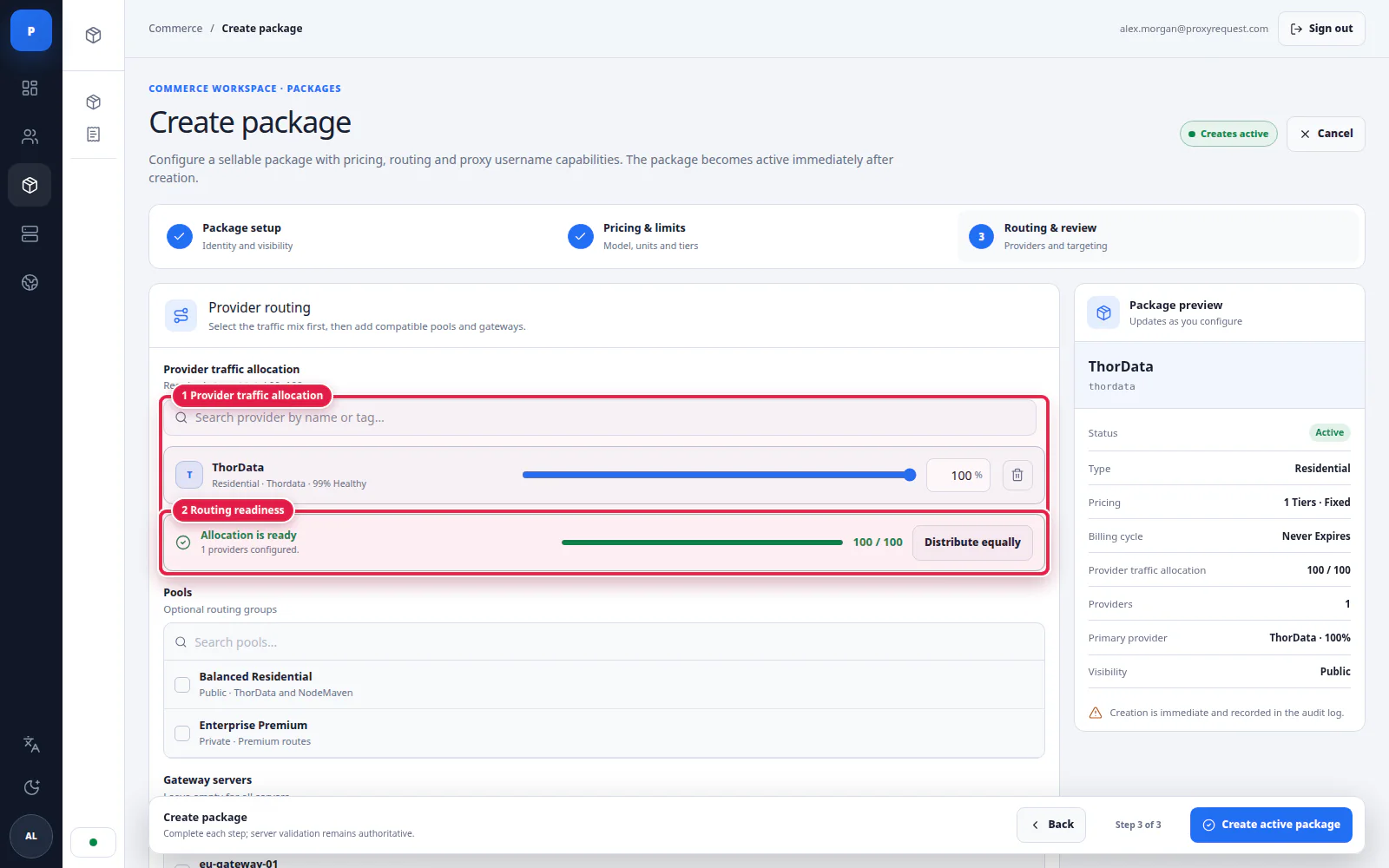
The multi-provider routing guide covers how eligibility, health, weights, and sessions work behind that boundary.
Choose the ownership model before the vendor
A provider-backed offer fits when speed matters more than supply independence and one provider’s catalog can remain your product. Independent software fits when you bring supply, need stable public interfaces, or want to change routing without migrating customers. The reseller program versus platform comparison covers margins, operations, migration, and contract questions in detail.
Questions to ask before buying
- Does the price include proxy traffic, software, or both?
- Can I connect upstream accounts contracted in my company’s name?
- Can one package route across several suppliers?
- Which domains can I control?
- Can customers ever receive upstream hostnames or raw errors?
- Who owns and exports customer, order, and ledger data?
- How are usage and hard limits enforced?
- Are dashboard, API, gateway, monitoring, backups, and upgrades included?
- Which branding changes are included and which are custom?
- What is the migration path if the relationship ends?
If a demo cannot answer these questions through one end-to-end request, the term “white-label” is doing too much work.
For the broader stack, continue to what proxy reseller software actually needs. If you are beginning from supply and a business idea, use the proxy business launch guide.